FieldEyes Reviews may earn an affiliate commission when you buy through links on this page, at no extra cost to you. Read our full affiliate disclosure and review policy
A battery powered security camera lets you place a camera where running power cable is impractical. This guide explains how that works in practice, then compares two solar-assisted outdoor listings currently available — the JOOAN 4K Dual Lens and the Baseus Security S1 Lite — using only what their sellers advertise.
If you are trying to cover a gate, a shed, a lease road or a yard corner with no outlet nearby, a battery-and-solar camera is the practical category to look at. The short version: both listings below advertise battery power with a solar panel for continuous charging, both are wireless Wi-Fi outdoor cameras, and both are advertised by their sellers — not verified by us. The rest of this page is what each listing actually claims, who each suits, and the questions worth answering before you order.
How a battery powered security camera works
A battery powered security camera stores energy in an internal or removable battery instead of drawing mains power through the wall. Because there is no cable to a socket, you can mount it on a post, under an eave or on an outbuilding. The trade-off is that you are responsible for keeping it charged. Cameras in this category usually manage that in one of three ways:
- Manual charging — you take the camera down (or open a port) and charge it by cable. Simple, but a chore on a camera mounted high or far from the house.
- Solar top-up — a panel keeps the battery topped up in suitable sunlight. This is the approach both listings below advertise.
- Motion-activated wake — the camera stays idle until its motion sensor triggers recording, which stretches battery life between events.
Neither listing supplied battery capacity, expected runtime between charges, or solar panel wattage, so there is no honest number to give you here. Those are the first figures to check on the seller's page before you buy.
The two listings compared
| Feature | JOOAN 4K Solar | Baseus Security S1 Lite |
|---|---|---|
| Advertised resolution | 4K | 2K |
| Power | Battery with solar charging (advertised) | Battery with continuous solar power (advertised) |
| Lens / field of view | Dual lens (advertised); FOV not stated | 135° FOV (advertised) |
| Weather rating | Not verified | IP67 (advertised) |
| Detection | PIR human detection (advertised) | Not verified |
| Night vision | Advertised; type not stated | Not verified |
| Connectivity | Wireless (advertised) | Wi-Fi (advertised) |
| Reference price | US$66.56 | US$74.33 |
| Battery capacity | Not stated in supplied data | Not stated in supplied data |
| Star rating / reviews | Unavailable in supplied data | Unavailable in supplied data |
"Not verified" means the seller listing information supplied to us did not include that figure — it does not prove the feature is absent. Prices are changeable reference figures; check the current price, your variant and your delivery destination at checkout.
JOOAN 4K Solar Security Camera
Sold through the JOOAN Official Store, this listing advertises a 4K wireless outdoor camera with a dual lens, solar charging, PIR human detection and night vision. A dual-lens design is typically advertised to capture two views at once — often a wide overview plus a closer or zoomed framing — but the listing supplied to us does not explain what each lens does, so confirm that on the seller's page.
JOOAN 4K Solar Security Camera Wireless Outdoor Dual Lens Solar IP Camera PIR Human Detection Night Vision Battery CCTV Camera
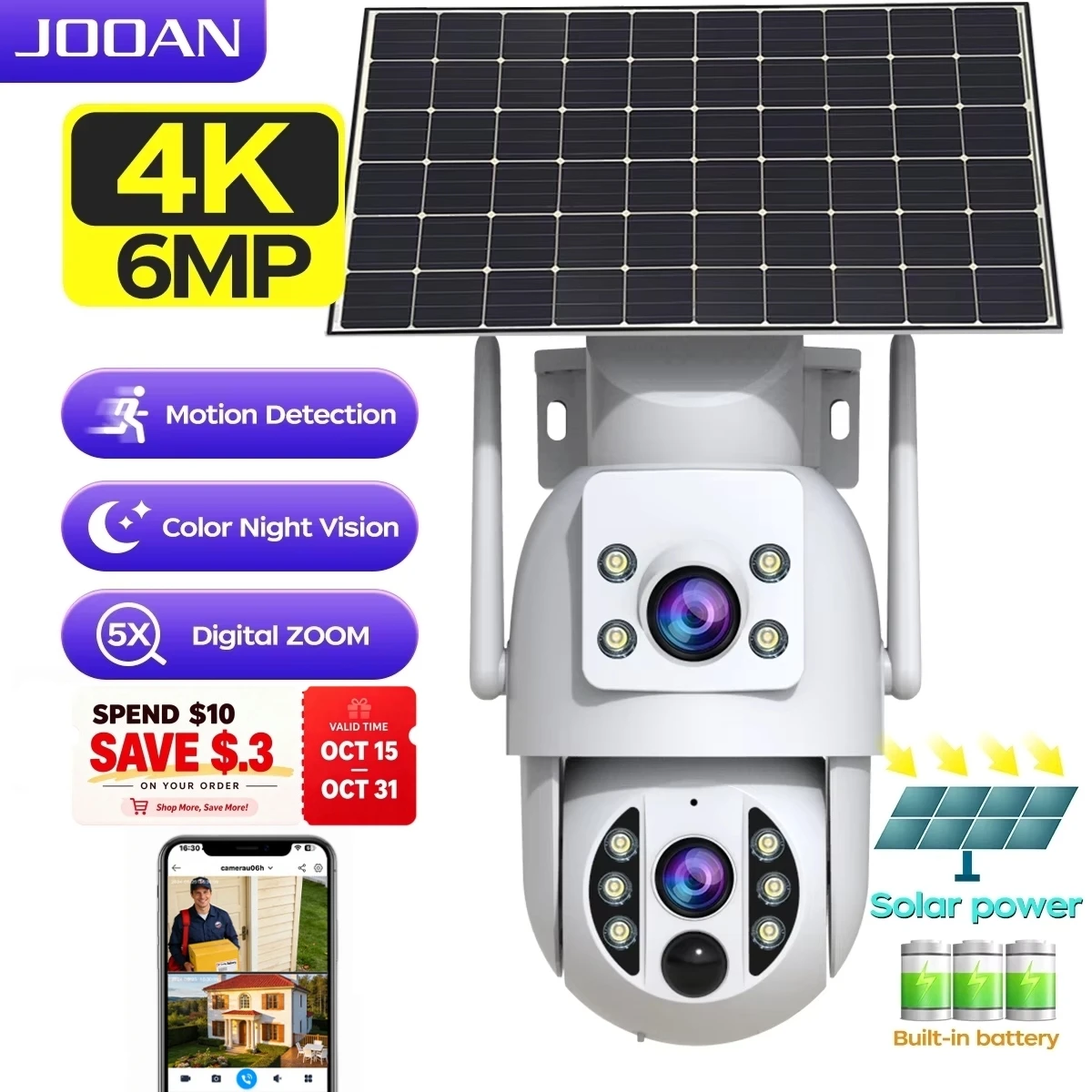
Specs listed reflect seller claims. Sensor arcs, nighttime illumination, and battery longevity vary with weather, foliage, and mounting.
Who it suits: a buyer who wants the highest advertised resolution of the two and prefers a camera that flags human-shaped motion rather than recording everything. On a hunting lease or outbuilding, the human-detection claim could cut down on clip review from passing animals — if it works as advertised in your placement.
Limitations to weigh: no IP weather rating, battery capacity, field of view or app details were supplied. Solar charging performance depends entirely on sunlight and panel placement, so ask the seller how long a full charge lasts under typical use and what happens on overcast stretches.
Baseus Security S1 Lite Solar Camera
Sold through the BASEUS Co.,Ltd. Store, the S1 Lite advertises 2K resolution, a 135° field of view, IP67 weather resistance, Wi-Fi connectivity, and what the seller calls continuous power from its solar panel. The "Lite" naming suggests a step-down model in Baseus's range, but the supplied data does not confirm how it differs from a non-Lite version.
Baseus Security S1 Lite Solar Security Camera Wireless Outdoor Camera Continuous Power 2K Resolution 135°FOV IP67 Wifi Camera

Specs listed reflect seller claims. Sensor arcs, nighttime illumination, and battery longevity vary with weather, foliage, and mounting.
Who it suits: a buyer who prioritises a stated weather rating and a wide single-lens view over raw resolution. A 135° field of view, if accurate, covers a broad foreground — useful for a driveway or yard corner — at the cost of the extra framing a dual-lens setup might offer.
Limitations to weigh: "continuous power" is a seller phrase. No battery capacity, night vision specification, motion detection type or local/cloud storage details were supplied. Ask whether footage is stored to a card, to the cloud, or both, and whether any subscription is required.
Which one fits your situation
Neither listing is universally better — they point at different priorities:
- Choose the JOOAN listing if maximum advertised resolution and human-focused motion detection are your priorities, and you are comfortable verifying its weather rating and battery details first.
- Choose the Baseus listing if a stated IP67 rating and a wide 135° view matter more than 4K, and you prefer a brand-name store listing with a clear environmental spec on the page.
- If neither answers your questions about battery life, storage or app support, that is a sign to hold off rather than guess. A cheaper camera that dies in a fortnight or hides footage behind a subscription is not a bargain.
Questions to check before you order
Because both listings are advertised claims only, use these as your pre-purchase checklist on the seller's page and in direct questions to the store:
- Battery capacity and real-world runtime — how many days between charges under your expected event frequency?
- Solar expectations — does the panel fully recharge the battery, or only slow the drain? What is the recommended panel orientation?
- Weather rating — what IP rating does the exact variant carry, and is the mounting hardware rated for your climate?
- Storage — local microSD, cloud, or both? Is a paid plan needed for recorded playback?
- Wi-Fi requirements — does it need 2.4 GHz only, and is that signal strong enough at your mounting point?
- Variant and destination — confirm the exact option you are buying, current price, and delivery eligibility for your address at checkout.
For mounting height, fixing method and load on any surface, follow the manufacturer's instructions included with the exact product, or get advice from a qualified installer — do not rely on generic online rules of thumb for screws, anchors or drilling.
Where this comparison comes from
This article is based on the seller listing information supplied for two AliExpress listings (captured 19 October 2026) and general guidance on battery powered cameras. We have not tested either camera, audited the sellers, or independently verified any specification. Star ratings and review counts were not available in the supplied data. Where a claim could not be supported, we have said so rather than filled the gap — treat every advertised figure above as a seller claim to confirm at the point of sale.
Evaluation is based on published specifications and seller listings. No physical or hands-on testing was conducted; unlisted specifications may still be available from the seller.
